
Höre diesen Podcast kostenlos in der App: Kostenlos im App Store laden
radio.de
Sleeptimer
Sender speichern
44 Episoden
Update im Juli 2026
10.07.2026 | 3 Min.Psychologie fürs Klassenzimmer als Buch (BELTZ Verlag)
Die 4K Im Gewand Empirischer Forschung: Eine Antwort Auf Albrecht Et Al. (2025) (Pre-Print)
Steht ein preisgekröntes Bildungsprojekt auf pseudowissenschaftlichem Fundament? (youtube)Dweck et al. (1995) | Growth Mindset
08.05.2026 | 20 Min.Thema: Growth Mindset
Um diese Studie geht es: Dweck, C. S., Chiu, C.-y., & Hong, Y.-y. (1995). Implicit theories and their role in judgments and reactions: A world from two perspectives. Psychological Inquiry, 6(4), 267–285.
Weitere Forschung:
Sisk, V. F., Burgoyne, A. P., Sun, J., Butler, J. L., & Macnamara, B. N. (2018). To what extent and under which circumstances are growth mind-sets important to academic achievement? Two meta-analyses. Psychological Science, 29(4), 549–571.
Macnamara, B. N., & Burgoyne, A. P. (2023). Do growth mindset interventions impact students’ academic achievement? A systematic review and meta-analysis. Educational Research Review, 38, 100503.Spezial: Die Bildungsweltmeister | Gespräch mit Alexander Brand
13.04.2026 | 34 Min.In dieser Spezialfolge unterhalte ich mich mit dem Bildungsjournalisten Alexander Brand über seine Reise in die erfolgreichsten Bildungssysteme der Welt, sein Buch „Die Bildungsweltmeister“ und die Frage, was wir aus Ländern wie Finnland oder Singapur für unser eigenes Bildungssystem lernen können.
im Online-Buchhandel:
"Die Bildungsweltmeister" von Alexander Brand
ab 16.07.2026: "Psychologie fürs Klassenzimmer": Das Buch zum PodcastRoberts et al. (2006) | Persönlichkeitsentwicklung
06.04.2026 | 22 Min.Thema: Persönlichkeitsentwicklung
Um diese Studie geht es:
Roberts, B. W., Walton, K. E., & Viechtbauer, W. (2006).Patterns of mean-level change in personality traits across the life course: A meta-analysis of longitudinal studies. Psychological Bulletin, 32(1), 1–25.
Weitere Forschung:
Hudson, N. W., & Fraley, R. C. (2015). Volitional personality trait change: Can people choose to change their personality traits?
Journal of Personality and Social Psychology, 109(3), 490–507.
Magidson, J. F., Roberts, B. W., Collado-Rodriguez, A., & Lejuez, C. W. (2014). Theory-driven intervention for changing personality: Expectancy value theory, behavioral activation, and conscientiousness. Developmental Psychology, 50(5), 1442–1450.Rozenblit & Keil (2002) | Methodenvielfalt
25.03.2026 | 21 Min.Thema: Methodenvielfalt
Um diese Studie geht es:
Rozenblit, L., & Keil, F. C. (2002). The misunderstood limits of folk science: An illusion of explanatory depth. Journal of Cognition, 7(1), 1–15.
Erwähnt:
Helmke, A., & Jäger, R. (2002). Das Projekt MARKUS. Mathematik-Gesamterhebung Rheinland-Pfalz: Kompetenzen, Unterrichtsmerkmale, Schulkontext. Landau: Verlag Empirische Pädagogik.
Krammer, K. (2021). Methodenvielfalt im Unterricht und ihre Wirkung auf Lernerfolg (Masterarbeit). Universität Graz. https://unipub.uni-graz.at/obvugrhs/content/titleinfo/6802188/full.pdf
Meyer, H. (2004). Was ist guter Unterricht? Berlin: Cornelsen.
Huber, S. G., & Hader-Popp, S. (2008). Unterrichtsentwicklung durch Methodenvielfalt im Unterricht fördern. http://schulegestalten.net/pdf/Huber-HaderPopp-2008-UnterrichtsentwicklungDurchMethodenvielfaltImUnterrichtF%C3%B6rdern.pdf
Weitere Forschung:
Mills, C. M., & Keil, F. C. (2004). Knowing the limits of one’s understanding: The development of an illusion of explanatory depth. Journal of Experimental Child Psychology, 87(1), 1–32.
Zemla, J. C., Sloman, S. A., Bechlivanidis, C., & Lagnado, D. A. (2024). Subjective understanding is reduced by mechanistic explanation. Journal of Cognition, 7(1), 1–15.
Weitere Wissenschaft Podcasts






Trending Wissenschaft Podcasts




















Über Psychologie fürs Klassenzimmer
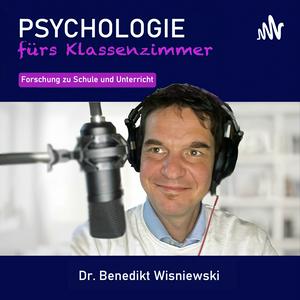
In diesem Podcast geht es um Forschung zu Schule und Unterricht, die jede Lehrerin und jeder Lehrer kennen sollte.
In jeder Folge stelle ich Ihnen eine Studie, ein Review oder eine Metaanalyse vor, die für didaktische und pädagogische Erwägungen von Praktikerinnen und Praktikern relevant ist. Dabei gehe ich sowohl auf 'Klassiker' als auch auf aktuelle Forschung ein.
Ich bin Schulpsychologe, nebenbei seit vielen Jahren in der Forschung tätig und habe früher zwölf Jahre lang selbst unterrichtet.
https://bsky.app/profile/benwisniewski.bsky.social
Podcast-WebsiteHöre Psychologie fürs Klassenzimmer, Kettenreaktion – Der Wissenschafts-Podcast von Dirk und Sabine Steffens und viele andere Podcasts aus aller Welt mit der radio.de-App
Hol dir die kostenlose radio.de App
- Sender und Podcasts favorisieren
- Streamen via Wifi oder Bluetooth
- Unterstützt Carplay & Android Auto
- viele weitere App Funktionen
Hol dir die kostenlose radio.de App
- Sender und Podcasts favorisieren
- Streamen via Wifi oder Bluetooth
- Unterstützt Carplay & Android Auto
- viele weitere App Funktionen

Psychologie fürs Klassenzimmer
Code scannen,
App laden,
loshören.
App laden,
loshören.
 Deutschland
